
Stage Blocking Guide for Directors
Everything you need to know about planning, recording, and communicating actor movement on stage.
What Is Stage Blocking?
Stage blocking is the precise planning and recording of actor movement during a theatrical production. It defines where actors stand, when they move, and how they navigate the stage in relation to the set, other actors, and the audience.
Blocking is typically set by the director during rehearsals and recorded by the stage manager in the prompt book. Good blocking supports the story, creates visual composition, and ensures actors are in the right position for lighting, sound, and scenic cues.
Whether you're directing a small black box production or a large proscenium show, understanding blocking fundamentals is essential for clear communication with your team.
Stage Directions
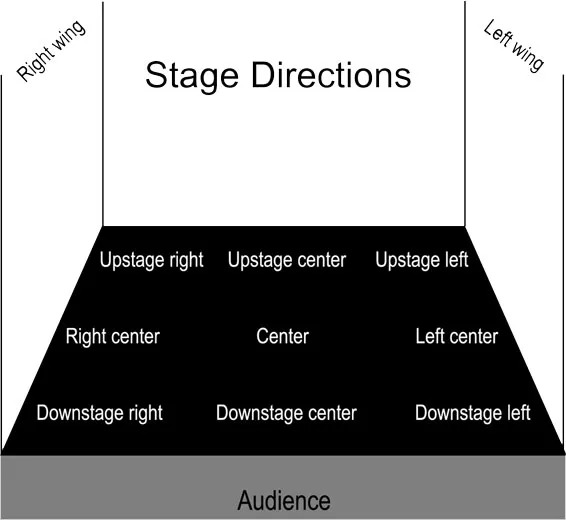
Stage directions are always given from the actor's perspective, facing the audience. This can be counterintuitive at first, but it's the universal standard in theatre.
Upstage (US)
The area farthest from the audience. Named from the era of raked stages, when walking away from the audience meant walking uphill.
Downstage (DS)
The area closest to the audience. The most powerful position on stage for direct address and intimate scenes.
Stage Left (SL)
The left side of the stage from the actor's perspective (facing the audience). Audience right.
Stage Right (SR)
The right side of the stage from the actor's perspective. Audience left.
Center (C)
The middle of the stage. Often combined with upstage or downstage — UC (upstage center), DC (downstage center).
Blocking Notation
Stage managers use a shorthand system to record blocking efficiently. While notation can vary between stage managers, these are the most common abbreviations used in professional theatre:
| Abbreviation | Meaning |
|---|---|
| X | Cross (move from one area to another) |
| XDR | Cross downstage right |
| Ent. | Enter |
| Ex. | Exit |
| SIT | Sit down |
| RISE | Stand up |
| XDSC | Cross downstage center |
| AB | Above (upstage of a furniture piece) |
| BL | Below (downstage of a furniture piece) |
These abbreviations are written next to the relevant line in the script, often with the character's initial. For example, "J X DSL" means "Julia crosses downstage left."
Common Blocking Symbols and Diagrams
In addition to written shorthand, blocking is often recorded with simple diagrams — a top-down sketch of the stage with character positions marked. Here's what the notation looks like in practice.
Character Initials
Characters are represented by their initial or a two-letter abbreviation. In a large cast, initials can conflict — in those cases, use the first two letters of the last name, or assign arbitrary abbreviations and keep a key in the front of your prompt book.
Position Circles
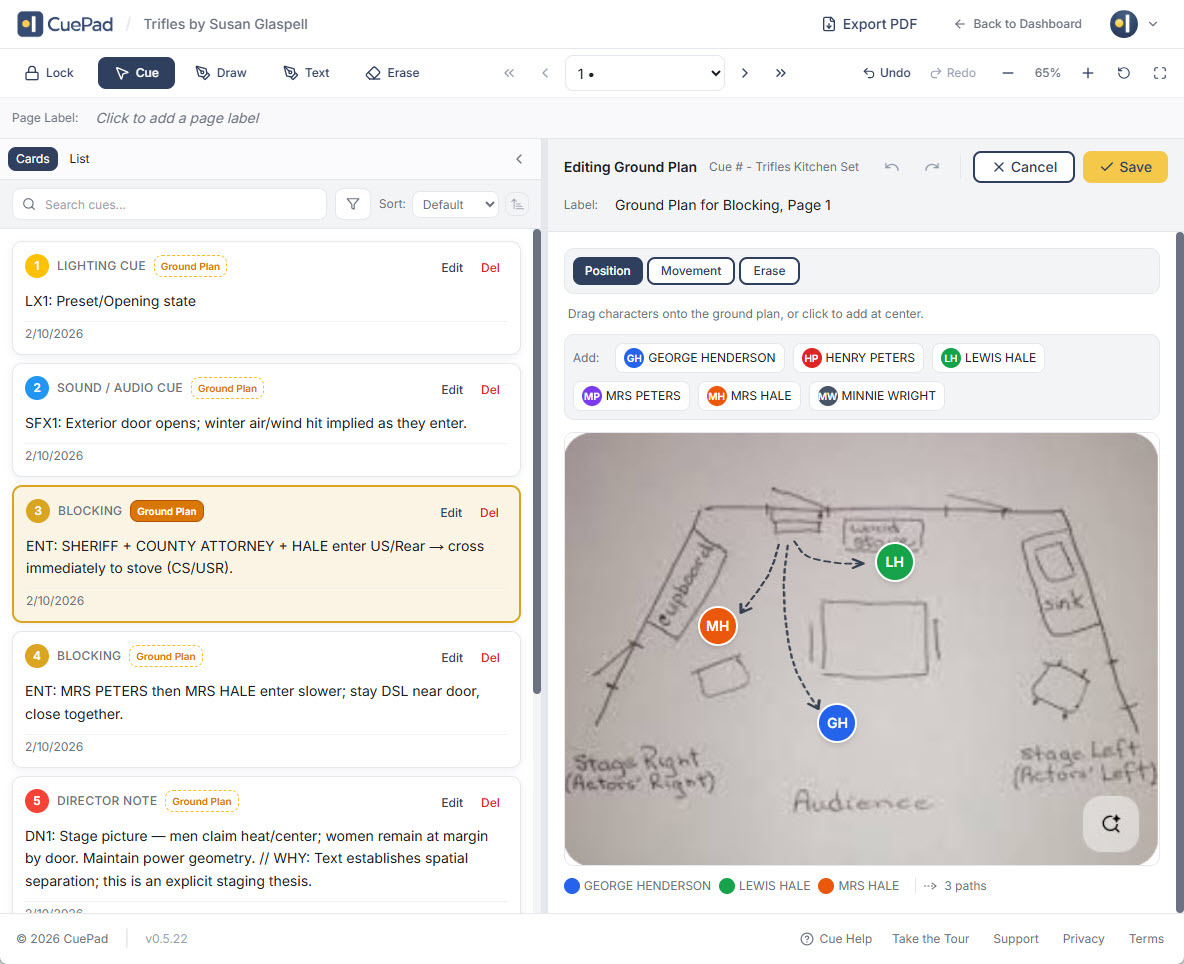
A circled initial marks a character's position on the ground plan at a given moment. When a character moves, draw an arrow from the old position to the new one.
The Facing-Page System
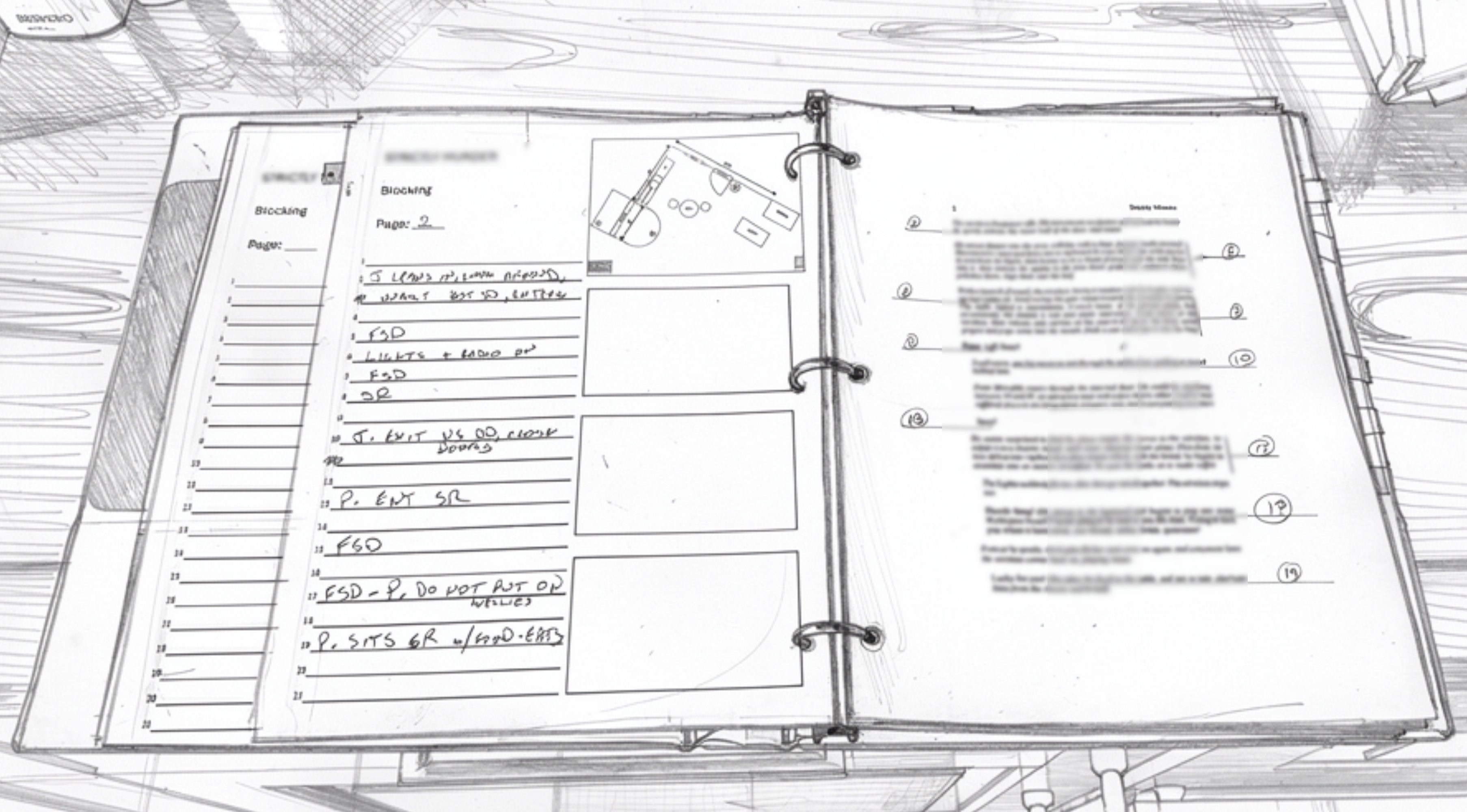
In the classic paper prompt book, blocking diagrams are drawn on the page facing the script. The script is on the right; the blocking notes and diagrams are on the left. The circled cue number in the script margin corresponds to the numbered entry on the facing page. This keeps the script readable while giving you space to record detail.
CuePad digitizes this system — cues are anchored to trigger text in the script, and ground plan snapshots are attached to each cue, recreating the facing-page relationship in a single view.
What to Record at Each Blocking Moment
At minimum, record: (1) which character moves, (2) where they move from, (3) where they move to, and (4) the trigger line or action that initiates the move.
Optional but useful: what prompted the move (director's intention), and any notes about obstacles or relationship to other characters.
Blocking Challenges and How to Handle Them
When Blocking Changes Mid-Rehearsal
Blocking changes are inevitable. When a director calls a change, cross out (or delete) the old blocking and record the new movement immediately. Don't try to hold the change in memory. If the change is significant — a full re-block of a scene — note the date and rehearsal number so you can track the history.
Tracking Blocking for Large Casts
For musicals or large-cast plays, tracking every character's position at every moment is impractical. Focus on principals and anyone involved in a technical cue. For ensemble scenes, note group formations rather than individual positions — “full company downstage arc” is more useful than mapping 16 positions.
When Actors Deviate from Set Blocking
During runs, note when actors consistently deviate from set blocking — especially if the deviation affects a technical cue. Raise it in the production meeting or quietly with the actor before a run. Updating the prompt book to reflect what's actually happening on stage is always better than keeping a record that doesn't match reality.
Locking Blocking for Tech
Blocking should be locked before tech week begins. Lighting, sound, and scenic cues are set to specific actor positions — if an actor's blocking changes after tech, cues may need to be reset. Flag any unlocked blocking in your prompt book before the first tech rehearsal.
Recording Blocking in a Prompt Book
Traditionally, blocking is recorded in a paper prompt book — a binder containing the script with wide margins for notes. The stage manager writes blocking shorthand next to the corresponding line, and may include small diagrams showing positions on a ground plan.
Digital tools like CuePad modernize this process by letting you attach blocking notes directly to the script text, place characters on interactive ground plans, and draw movement paths — all without paper.
The Blocking Workflow
Blocking typically follows a predictable cycle during the rehearsal process:
- 1
Pre-blocking
The director plans initial blocking at home, often using a ground plan and miniatures or a digital tool.
- 2
Blocking rehearsals
The director walks actors through the movement, scene by scene. The stage manager records every move.
- 3
Working rehearsals
Blocking is refined and adjusted as scenes develop. Changes are recorded in the prompt book.
- 4
Run-throughs
Full act or show runs test whether the blocking flows. Problem areas are identified and fixed.
- 5
Tech rehearsals
Blocking must be locked so lighting, sound, and scenic cues can be set to specific positions.
Record Blocking Digitally
CuePad gives you interactive ground plans, character placement, movement paths, and script annotations — all in one system.
Start Free with CuePad